Wednesday, 25 April 2018
23 April 2018 - Cancer Centre, Old QE Hospital
From 10 to 20 April, Deb completed her first course of the PCV chemotherapy. This was not as bad as expected but she was still sick a few times and very tired. This visit we saw Dr Sanghera and Claire, CNS. It was a short meeting for Dr Sanghera to review how Deb had got on. He said that she should not have to suffer being sick on this treatment and should take more anti sickness medication next time. Next visit to the hospital is on May 21 to see Dr Sanghera before Deb starts her next course of chemo on the 22nd.

Wednesday, 11 April 2018
10 April 2018 - Ward 621, Out-patients Oncology/Haematology Unit, QE Hospital
 |
| Deb having her Vincristine chemotherapy |
Visit to start Deb's chemotherapy. We got to the hospital at 1.15 for a 1.30 appointment. OK we then waited an hour or so but that's fine; there were a lot of people having chemotherapy. Deb was then called in to the unit and is prepared by the nurse - lots of questions, hands warmed up and cannula inserted. We spoke about what happened yesterday and that Deb is expecting to leave the hospital with some antibiotics. This worried the nurse who wandered off to see Mark the registrar who was consulted yesterday. They now decide to take more bloods from Deb (which were the same as yesterday) and decide that Deb needs a chest x ray. So we have to go down to the ground floor imaging department and wait 45 minutes for an x ray (the results are fine). By the time we get back to the chemo unit it is 4.30 and chemo can start.
2 things annoyed me about this visit:
1) I know they have to be cautious but the registrar made a decision based on the information he had yesterday. Nothing has changed but he now decides he needs a chest x ray. Why couldn't he just make a decision and stick by it. He did look about 21 and had a distinct lack of facial hair.
2) I expected the nurses to be more focused on what they were doing The bag containing Deb's chemotherapy had a notice on it saying 'Fatal if not taken intravenously'. Despite this the nurse wandered off, had chats to friends, went off to do other jobs. I know they do this all day and every day but these are dangerous drugs. They sent us home with two more lots of chemotherapy. The nurse was decidedly woolly as to when to take everything - anti-sickness, chemotherapy, antibiotics, laxatives, more anti sickness. Come on NHS these drugs are cytotoxic.
Monday, 9 April 2018
9 April 2018 - Ward 621 Out-patients Oncology/Haematology Unit, QE Hospital
 |
| View from 6th floor QE Hospital |
We were seen by a chemotherapy nurse Megan. She told Deb what the PCV treatment involved and the possible side effects (that took about half an hour and included risk of infection, anaemia, feeling sick, tiredness, hair loss etc etc.). She took blood from Deb which was then tested. The test results were ok. Throughout the meeting Deb was coughing. Megan went to consult a doctor as to whether Deb should start the chemo the next day. The doctor said she should but he would prescribe some antibiotics which Deb should take if her temperature went up above 38 or she showed any other signs of infection (diarrhoea, vomiting etc.) So the PCV chemotherapy starts tomorrow. Each cycle lasts 42 days and Deb has been booked in for 6 cycles. The dates are shown below:
| Date | Start Time | Treatment |
|---|---|---|
| Mon 09 Apr 18 | 15:00 | PCV attenuated (v6) |
| Tue 10 Apr 18 | 13:30 | PCV attenuated (v6) |
| Tue 22 May 18 | 14:00 | PCV attenuated (v6) |
| Tue 03 Jul 18 | 12:45 | PCV attenuated (v6) |
| Tue 14 Aug 18 | 12:00 | PCV attenuated (v6) |
| Tue 25 Sep 18 | 12:00 | PCV attenuated (v6) |
| Tue 06 Nov 18 | 12:00 | PCV attenuated (v6) |
To put it mildly, Deb is not looking forward to this treatment. It is not helped by the fact that she already feels unwell even before anything has started. But hopefully after 9 months without any treatment, the chemo will do something to slow tumour growth.
Monday, 26 March 2018
26 March 2018 - Cancer Centre, Old QE Hospital
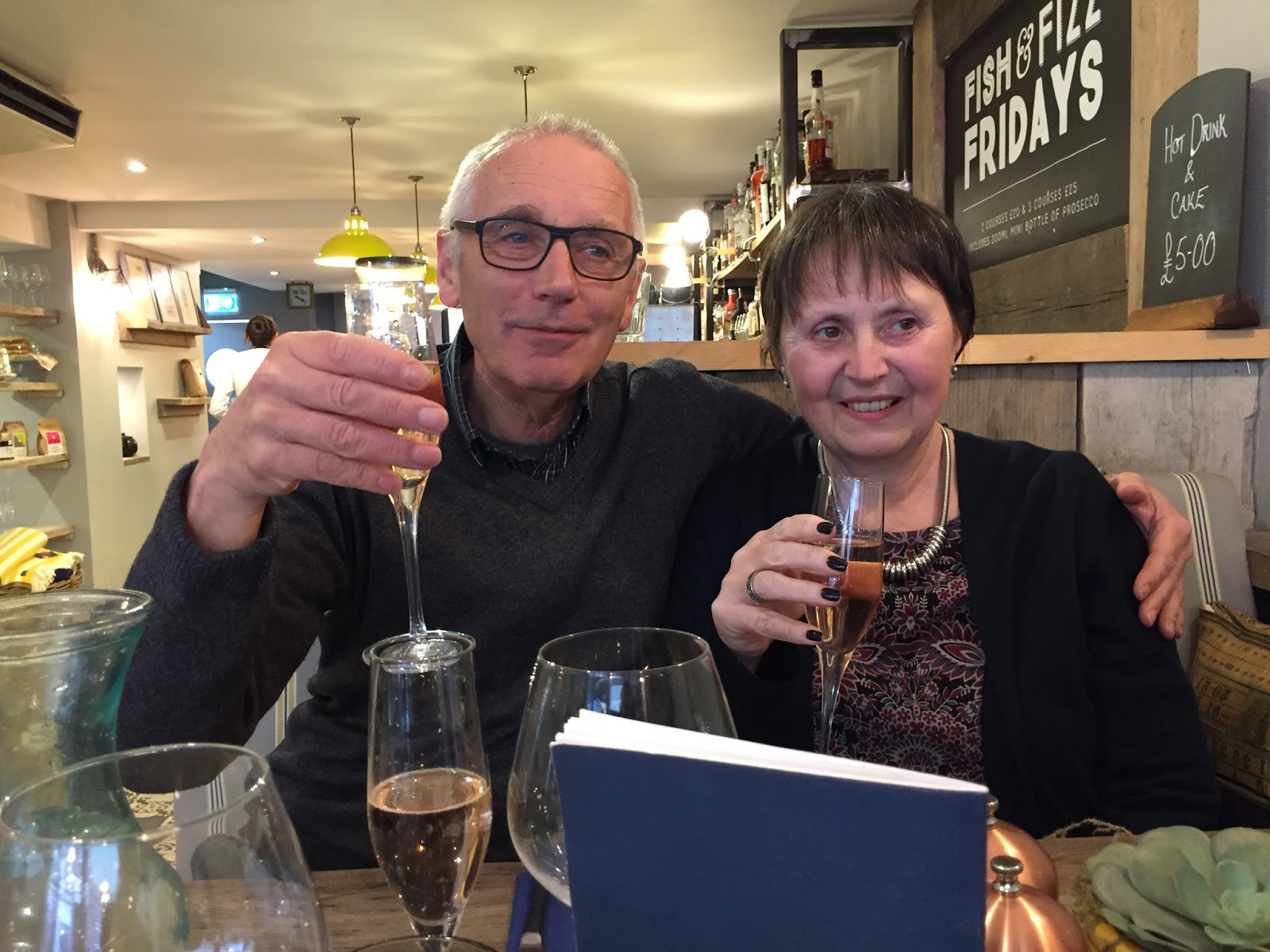 |
| Deb and I celebrating our 35th Wedding Anniversary |
Following Deb's decision not to have surgery, we had a meeting today with Dr Sanghera. The new CNS, Will was also present.
We briefly discussed Deb's decision not to have the operation. Dr Sanghera said that in his opinion we should still consider intervention. Because the Temozolomide chemotherapy had not proved as effective as he would have liked last time, Dr Sanghera suggested Deb should have PCV. This is a more aggressive chemotherapy consisting of 3 different chemotherapy drugs: procarbazine (P), lomustine (C - also known as CCNU) and vincristine (V) given on a 6 week cycle. The vincristine is given intraveneously at the hospital with the other 2 drugs are in tablet form. Deb has had PCV before in 2010/11 . The dose this time will be slightly lower. Deb will have 2 cycles and then have an MRI scan to monitor the effectiveness of the treatment. We will see Dr Sanghera again after the first cycle to see how everything is progressing. We wait for an appointment from the chemotherapy centre which is likely to be some time next week.
Saturday, 24 March 2018
24 March 2018 - UPDATE
Deb has made her decision about surgery. She has decided NOT to have the operation to debaulk the tumour. I agree with this decision - just look at the charts on the last post.
I telephoned the QE yesterday afternoon and told Claire, CNS Neurology, of Deb's decision. Today the hospital rang back to confirm that Deb had an appointment with Dr Sanghera in the Cancer Centre, the old QE at 10.30 Monday morning (26th). Will post again after that meeting.
I telephoned the QE yesterday afternoon and told Claire, CNS Neurology, of Deb's decision. Today the hospital rang back to confirm that Deb had an appointment with Dr Sanghera in the Cancer Centre, the old QE at 10.30 Monday morning (26th). Will post again after that meeting.
Tuesday, 20 March 2018
20 March 2018 - Meeting with Mr Kay, Neurosurgeon, QE Hospital
 |
| Queen Elizabeth Hospital Outpatients Dept. |
This was a very bleak meeting with Mr Kay, Neurosurgeon and Claire, CNS. Mr Kay started by asking Deb what she understood the current position to be. She responded by explaining that following the last meeting with Dr Sanghera, we were here to discuss surgery as an option for treatment. Mr Kay went on to discuss the risks of surgery. As for the first operation the tumour is close to the ventricles (which contain cerebral fluid) and other important structures in the brain and therefore all of the tumour could not be removed. Mr Kay stressed that because this was a second operation the postoperative risks were higher and these may include problems with the wound healing, a build up of fluid and inflammation of the brain (encephalitis) and a real risk of Deb not being mobile and spending her last months in hospital. He also said that the operation would not improve Deb's current condition, it would give in his words 'local disease control'. by that I think he means by removing some of the active tumour it will slow it down and give you a bit more time.
 |
| Chart showing possible outcomes from operation |
Mr Kay drew a chart like this showing the possible outcomes from the operation.
Blue line - best outcome - Deb's condition remains as now for a time before declining.
Yellow line - no operation - Deb's condition gradually declines with time but she has a longer relatively good quality of life.
Red line - possible outcome from operation - Deb has post op complications and declines rapidly. Her life expectancy may be the same but her quality of life is poorer.
Mr Kay said the decision was Deb's. He could not advise what to do. This was a decision where the positive and negative factors were equally balanced and it was up to Deb. I said that this was an impossible decision for Deb to make. I wanted more understanding of the benefits and downsides to make a pragmatic rational decision. Mr Kay said this was not a technical decision. It depended more on the type of person you were. Did you want more intervention and take the risk of possible complications or would you rather take the relatively good life you have now and run with it for as long as you can.
I said our decision is coloured by what happened last time. Deb had the operation followed by chemotherapy and 8 years of good quality life later is still here. Mr Kay said that Deb's longevity was not because of the operation and showed us this chart which we have seen before.
 |
| % of people who have survived with GBM v. survival time in months |
The graph shows that 60 months (5 years ) after diagnosis only 2% of people with GBM are still alive. This graph only goes up to 5 years, Deb is off the scale. The reason for that is unknown it is a combination of the type of GBM Deb has and the way it has responded to chemo/radiotherapy. The operation just debaulked the tumour and did not effect growth rates.
Claire said we should go away and make the decision about surgery in the next few days. They will of course implement whatever decision Deb takes. If Deb does not go ahead with surgery there is still radiotherapy and/or chemotherapy to be considered.
Below is a copy of Claire's notes about the meeting:

Tomorrow is my 70th birthday. I am glad we cancelled the party, I don't think we would have been much fun. Sam and Kate are here for the weekend. We will have a family discussion and Deb will decide what she will do.
Monday, 12 March 2018
12 March 2018 - Cancer Centre, Old QE Hospital
 |
| Deb today after visit to hospital |
Met with Dr Sanghera to discuss results of the scan Deb had on 23 February (her 45th) and possible future treatment.
We discussed how Deb had been feeling since the last appointment. Then Deb had decided to do nothing for 2 months as she was asymptomatic. It was felt that she could have a break for a couple of months feeling well before the treatment started. However for most of the time since Christmas Deb has been unwell. First she had the flu with a persistent cough and sickness. One night I woke up to find her limp and unresponsive in bed. The GP came out the next day and after tests said it was the flu and not the tumour. After feeling sick for weeks Deb then started to be sick. I mean being violently sick without warning. I mean just sitting up in bed and spewing all over the duvet cover. For about a week she could not eat anything without bringing it straight back up. The GP said this could be a bad infection or it could be due to the tumour and prescribed steroids (dexamethazone) to reduce any swelling in the brain. Deb eventually managed to keep some of this down and the sickness gradually subsided. Throughout the 2 months Deb has been weak, often having difficulty getting up and down stairs and also very dizzy. (GP thought this may be due to her low blood pressure).
Dr Sanghera examined the backs of Deb's eyes (ok). We reviewed the latest scan. It is difficult to quantify but you could see significant signs of tumour progression. The tumour is located in apart of the brain (right frontal lobe) which can accommodate significant growth before symptoms are apparent but Dr Sanghera thought that the inability of Deb to deal with her infections, her increased dizziness and the sickness could all be due to the tumour. At the current rate of growth Dr Sanghera thought that without treatment Deb would experience significant symptoms in 3 to 6 months. These may be increasing headaches, dizziness and sickness.
Dr Sanghera thought that there were 4 options for treatment:
1. Do nothing again and monitor tumour progress. Not really an option in my opinion.
2 Start chemotherapy (PCV). Dr Sanghera was not very enthusiastic about this option. If patients do not respond well to temozolomide ( and Deb hadn't this time) then typically they did not respond well to PCV (10 - 20% chance of slowing tumour growth).
3. Surgery to remove mass from the tumour.
4. Radiotherapy. As it is 10 years since Deb's last course of radiotherapy, this could be repeated.
Dr Sanghera's view was that surgery may well be the best option. After that we could look at other options to deal with the remainder of the tumour, perhaps radiotherapy and/or chemotherapy.
As a next step we will discuss the surgery option with Mr Kay the brain surgeon and we wait for an appointment date.
We were unsettled by the new direction. We had gone to the hospital expecting to start chemo and came out thinking about surgery. It is also disconcerting that last time we discussed surgery with Mr Kay he did not think it was appropriate as Deb was well. This time Dr Sanghera is saying surgery is appropriate because Deb is still well and could tolerate the operation better. We shall see what My Kay has to say.
Subscribe to:
Posts (Atom)